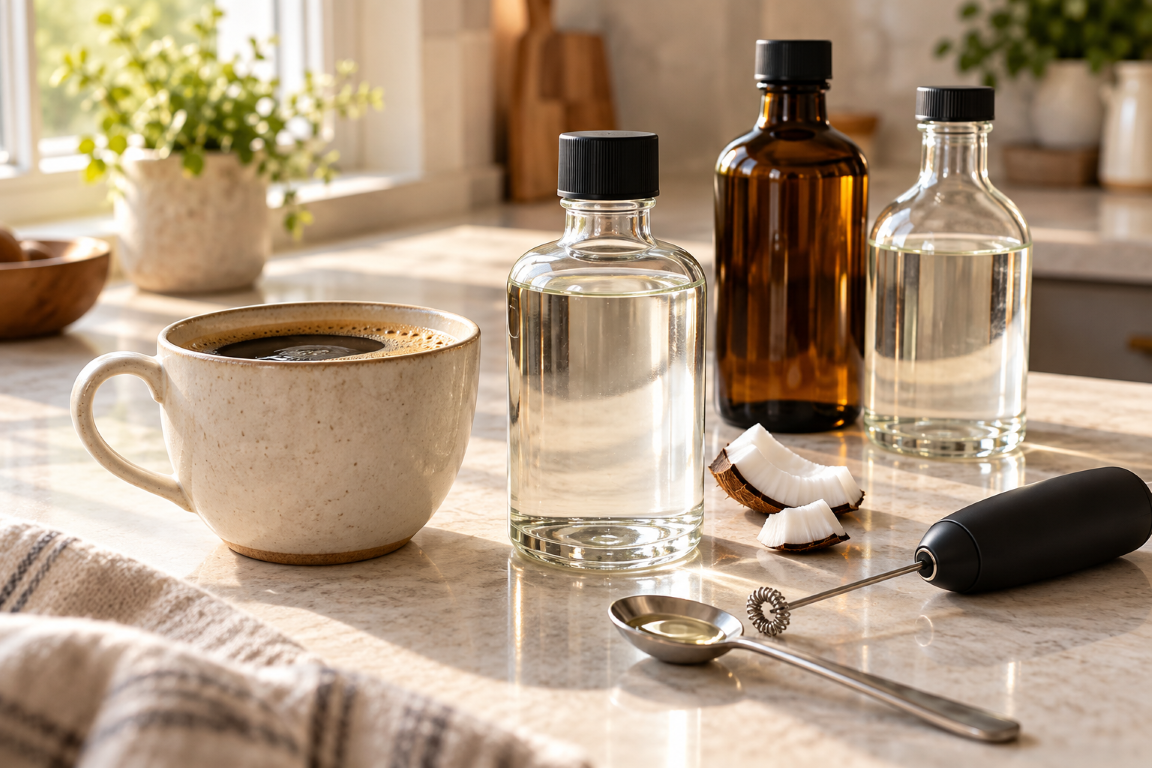
The best MCT oil for coffee is usually a high-quality pure C8 oil if your main goals are ketone production, energy, and mental performance. If you want something more affordable for everyday use, a C8/C10 blend can give you many of the same practical benefits without paying the premium that usually comes with pure C8.
My top pick for coffee is Bulletproof Brain Octane C8 MCT Oil because it contains 100% C8, also called caprylic acid. Research comparing different MCTs has consistently found C8 to produce a stronger ketone response than C10, C12, coconut oil, or typical C8/C10 blends.
But that doesn’t mean everyone needs the most expensive bottle of pure C8 they can find.
I’ve personally used Nature’s Way Organic MCT Oil, which contains both C8 and C10, and it remains one of the options I would consider for everyday coffee. It’s also the only product in this roundup I’ve personally used, so I’ll distinguish my firsthand experience from the other recommendations, which are based on their formulas, current product information, value, and how well they fit different coffee routines.
Let’s figure out which one actually makes sense for your cup.
TL;DR: What Is the Best MCT Oil for Coffee?
For maximum ketone production, Bulletproof Brain Octane C8 MCT Oil is my top choice because it contains pure C8 caprylic acid, the most ketogenic of the commonly used MCTs. For everyday value, Sports Research Organic C8 + C10 MCT Oil gives you a strong C8-heavy blend at a lower cost per ounce, while Nature’s Way Organic MCT Oil is my firsthand-tested pick. If you dislike the oily texture of liquid MCT, Bulletproof’s C8 MCT powder is worth considering instead.
Quick Comparison: Best MCT Oils for Coffee
| MCT Oil | Best For | MCT Type | What Stands Out |
|---|---|---|---|
| Bulletproof Brain Octane | Best overall for coffee | 100% C8 | Strongest choice for ketone production |
| Sports Research Organic MCT Oil | Best everyday value | C8 + C10 | C8-heavy organic blend and larger bottle |
| Nature’s Way Organic MCT Oil | My firsthand-tested pick | C8 + C10 | Organic, simple formula, easy everyday option |
| Viva Naturals Organic MCT Oil | Best budget organic option | Coconut-derived MCTs | Lower-priced organic liquid |
| Bulletproof Brain Octane C8 Powder | Best powder | C8 | Creamier coffee without the oily layer |
Prices change frequently, so I’d compare the current cost per serving before buying rather than choosing solely by sticker price.
Health note: MCT oil is a dietary fat and isn’t appropriate for every person or every medical situation. Talk with your healthcare provider before using it regularly if you have a medical condition, take medication, are pregnant or breastfeeding, or have concerns about adding concentrated fats to your diet.
Before You Buy: What Do C8 and C10 Actually Mean?
MCT stands for medium-chain triglyceride, but not every MCT oil contains exactly the same fats.
The number tells you how many carbon atoms are in the fatty acid chain.
That sounds terribly chemistry-class-ish, but there are really only a few names you need to recognize when you’re shopping.
C8: Caprylic Acid
C8 is caprylic acid, an eight-carbon medium-chain fatty acid.
This is the one I would pay the most attention to if you’re buying MCT oil specifically for coffee and your goals include ketone production.
Controlled research comparing different MCTs found C8 produced the strongest ketone response. A review of the evidence concluded that C8’s ketogenic effect was about three times greater than C10 and six times greater than C12.
That doesn’t mean C8 guarantees better focus or endless energy. It means C8 is particularly effective at increasing ketones, which can serve as an alternative energy source.
That’s why you’ll see pure C8 oils marketed at a premium.
C10: Capric Acid
C10 is capric acid, which contains ten carbons.
Your body can still use C10 as an MCT, and it can contribute to ketone production, but it doesn’t appear to increase ketones as strongly as C8.
That’s not necessarily a reason to avoid it.
Combining C8 and C10 gives manufacturers a more affordable MCT oil that can still work very well as an everyday coffee addition. Commercial MCT oils commonly contain a mixture of these two fatty acids.
If you’re not specifically chasing the largest possible ketone response, a quality C8/C10 blend may be all you need.
C6: Caproic Acid
You may occasionally see C6, or caproic acid, mentioned when reading about MCTs.
You generally don’t need to look for it.
Although C6 technically falls within the medium-chain family, it is not commonly used as the primary fat in consumer MCT supplements. One reason is considerably less glamorous than metabolic science: it can have an unpleasant smell and taste.
Your coffee deserves better.
C12: Lauric Acid
C12 is lauric acid, a 12-carbon fatty acid naturally abundant in coconut oil.
Some MCT supplements include C12, while others concentrate primarily on C8 and C10.
If ketone production is your main reason for buying MCT oil, I would prioritize C8 over C12. Research comparing chain lengths has found C12 to be substantially less ketogenic than C8.
This is also why coconut oil and concentrated MCT oil aren’t interchangeable. Coconut oil contains multiple fatty acids, while a pure C8 product isolates the particular MCT you’re trying to get more of.
1. Best MCT Oil for Coffee Overall: Bulletproof Brain Octane C8 MCT Oil
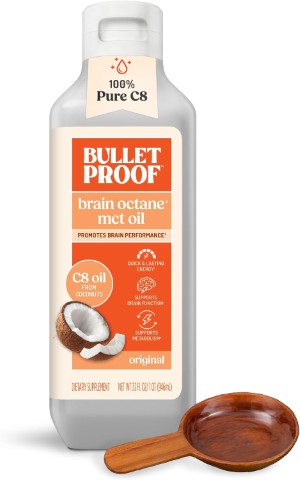
If you’re asking me to choose one MCT oil specifically for coffee, this would be it.
Bulletproof Brain Octane contains 100% coconut-derived C8 caprylic acid rather than a C8/C10 blend. Bulletproof currently lists its 16-ounce bottle at $29.99, although prices can change.
Why I Recommend It
The biggest reason isn’t the Bulletproof name. It’s the C8.
If you’re spending money on MCT oil because you’re interested in ketones, pure C8 gives you the strongest evidence-backed reason to pay extra. In controlled testing, C8 produced a significantly larger ketone response than C10, coconut oil, and conventional C8/C10 MCT oil.
It is also flavorless, so you can add it without deliberately turning your coffee into coconut coffee.
Who It’s Best For
I would choose Brain Octane if:
- Ketone production is one of your main goals.
- You specifically want pure C8.
- You’re willing to spend more for a concentrated C8 oil.
- You regularly use MCT oil in coffee rather than simply wanting a general-purpose cooking oil.
What to Keep in Mind
You’re paying considerably more per ounce than you would for many blended MCT oils.
That premium makes more sense if you actually care about the difference between C8 and C10. If you simply want to experiment with adding MCTs to your morning coffee, you don’t necessarily need to begin here.
2. Best Value for Everyday Coffee: Sports Research Organic C8 + C10 MCT Oil
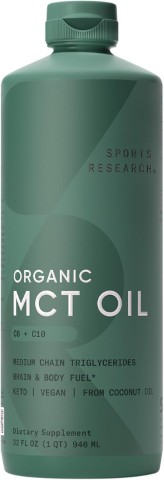
If Brain Octane is the performance-focused choice, Sports Research Organic MCT Oil is the one I’d look at when you want a larger everyday bottle without jumping to premium C8 pricing.
Its C8/C10 version provides about 9 grams of C8 and 4.7 grams of C10 per tablespoon, so C8 still makes up the majority of its MCT profile. A 32-ounce bottle was listed at $26.95 when I checked.
Compare that with roughly the same price for 16 ounces of Brain Octane, and you can see where the value argument comes from.
Why I Recommend It
You aren’t giving up C8. You’re simply getting it alongside C10.
Sports Research uses organic coconut-derived MCT oil, and its C8/C10 formula is USDA Organic.
This makes it a particularly good option if you plan to use MCT oil regularly and don’t need every serving to be pure C8.
Who It’s Best For
Consider Sports Research if:
- You want a C8-heavy MCT oil without pure-C8 pricing.
- You use MCT oil frequently.
- Organic coconut sourcing matters to you.
- You want a larger bottle that offers better value per ounce.
If you’re new to MCT oil, this is the sort of bottle I would be perfectly comfortable starting with.
3. My Firsthand Pick: Nature’s Way Organic MCT Oil
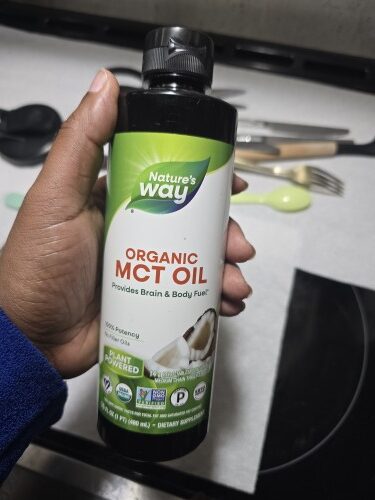
Nature’s Way Organic MCT Oil is the product on this list that I have personally used.
That matters because I don’t want to give you the impression I’ve poured every product in this roundup into my own coffee. I haven’t.
Nature’s Way is the one I can include based on actual use as well as its formula.
It is made from organic coconut MCT oil and provides 14 grams of MCTs per tablespoon from C8 and C10. Nature’s Way also lists it as USDA Organic and Non-GMO Project Verified, without palm oil or filler oils. The current 16-ounce price on the company’s website is $17.88.
Why It Still Makes My List
After digging further into the difference between MCT types, I would choose pure C8 over Nature’s Way if my specific priority were maximizing ketone production.
That doesn’t suddenly make the Nature’s Way bottle a bad choice. Far from it.
A C8/C10 blend still gives you the two MCTs you’re most likely to be looking for, and Nature’s Way keeps the ingredient list wonderfully uncomplicated.
It has also ranked very prominently among MCT oils on Amazon. I wouldn’t choose a supplement solely because Amazon puts a shiny badge beside it, but strong consumer adoption combined with a straightforward formula certainly doesn’t hurt.
Who It’s Best For
Nature’s Way is worth considering if:
- You want an organic C8/C10 blend.
- You prefer a recognizable supplement brand.
- You want something straightforward for daily coffee.
- Pure C8 isn’t important enough to you to justify paying a premium.
For me, this is also a good example of why learning what C8 and C10 actually mean changes the way you shop. I used Nature’s Way before digging this deeply into the different MCT profiles. Knowing what I know now, I’d still consider it a good everyday MCT oil, but I’d choose a pure C8 product for a more targeted ketone-focused experiment.
4. Best Budget Organic Option: Viva Naturals Organic MCT Oil
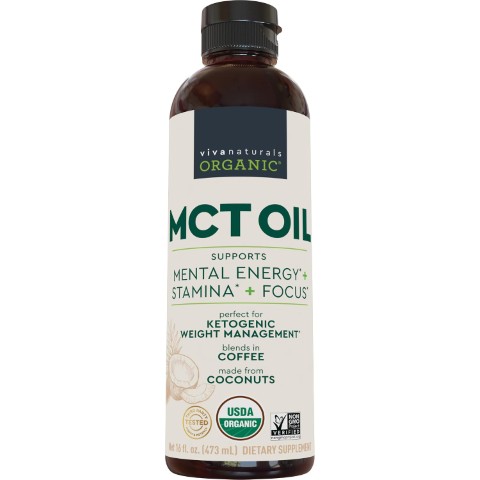
If price is playing a big role in your decision, Viva Naturals Organic MCT Oil deserves a look.
Its organic MCT oil is derived from organic coconut oil, and Viva Naturals lists the product as USDA Organic, Non-GMO Project Verified, vegan, Paleo Certified, and keto-friendly. At the time I checked, the 16-ounce bottle was listed at $16.99 on Viva Naturals’ website.
That puts it noticeably below several of the other organic options.
Why I Recommend It
This is the bottle I’d consider when someone tells me:
“I want to try MCT oil in my coffee, but I am absolutely not paying premium biohacker prices yet.”
Fair enough.
You can always move to pure C8 later if you decide MCT coffee is something you genuinely want in your routine.
Viva Naturals also specifically recommends beginning with 1 teaspoon and gradually working up to 1 tablespoon, which is sensible advice for anyone new to MCT oil.
5. Best MCT Powder for Coffee: Bulletproof Brain Octane C8 MCT Powder
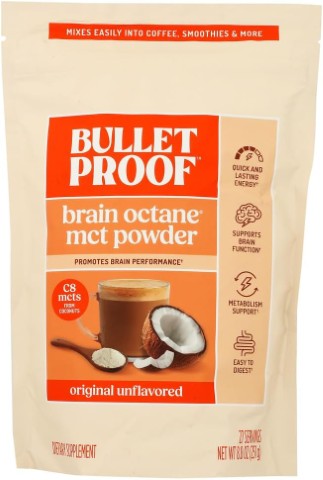
Some people like the effects they’re looking for from MCT oil but cannot get past the oil slick floating on top of their coffee.
Enter the powder.
Bulletproof Brain Octane C8 MCT Powder provides 6 grams of coconut-derived C8 per scoop and is designed to dissolve into drinks with a creamier texture. The current formula uses tapioca maltodextrin, sodium caseinate, and silicon dioxide along with the C8, so it is not simply powdered pure oil, and it contains milk.
That’s an important distinction when comparing powder with liquid MCT.
Why I Recommend It
The powder format can make sense if:
- You dislike an oily surface on your coffee.
- You want something easier to scoop and mix.
- You prefer a creamier coffee.
- Convenience matters more than getting pure liquid C8 with no carrier ingredients.
Bulletproof currently lists the 8.8-ounce container at $29.99.
Personally, I’d choose liquid C8 when purity and ketone production are the priorities.
I’d choose the powder when actually enjoying my coffee is likely to determine whether I stick with the routine.
The theoretically perfect supplement isn’t terribly useful if you hate drinking it.
C8 vs. C10: Which MCT Oil Is Better?
If you’re choosing based specifically on ketone production, C8 wins.
Research in healthy adults has repeatedly found C8 to have a stronger ketogenic effect than C10. One evidence review estimated C8’s ketogenic effect at roughly three times that of C10.
That makes pure C8 my preferred choice if you’re looking for MCT oil primarily for:
- Ketosis
- Ketone production
- A more targeted coffee-biohacking experiment
- Potential brain-fuel applications associated with increased ketones
But C10 isn’t “bad.”
A C8/C10 blend is often more affordable and still provides a meaningful amount of C8. That makes blends attractive for everyday use when you aren’t trying to maximize every possible ketone response.
So I would simplify the decision this way:
Choose pure C8 for performance and ketone-focused goals. Choose C8/C10 for value and everyday use.
Is It Okay to Put MCT Oil in Hot Coffee?
Yes, you can put MCT oil in hot coffee.
Normal brewed coffee temperatures are not a problem for MCT oil. Bulletproof, for example, says its liquid Brain Octane C8 can be used in recipes at temperatures up to 320°F, which is well above the temperature of coffee you’re actually going to drink.
The bigger issue isn’t heat. It’s mixing oil and water.
If you simply pour MCT oil into coffee and give it a lazy little swirl with a spoon, don’t be surprised when some of the oil decides it would rather live upstairs.
A handheld milk frother can emulsify it much more effectively and give you a smoother cup.
A blender also works, but be careful when blending hot liquids. Steam creates pressure inside closed containers, so only use equipment specifically designed to handle hot liquids and follow its directions.
A coffee-covered kitchen ceiling is not an advanced biohack.
How Much MCT Oil Should You Add to Coffee?
Start smaller than you think you need.
A review of research on MCT supplementation recommends beginning with about 5 grams of C8 or a C8/C10 combination, then gradually increasing as tolerated. Gastrointestinal discomfort and diarrhea become more likely as doses climb.
For many products, that works out to roughly 1 teaspoon as a beginner serving, although you should check the label on your specific bottle.
You can then decide whether increasing toward a tablespoon makes sense for you.
There is no prize for using the largest serving.
If one teaspoon gives you what you want without turning your digestive system into an angry group chat, that is useful information.
What Should You Look for When Buying MCT Oil for Coffee?
You don’t need to compare fifty bottles. I would concentrate on a few things.
Look at the Actual MCT Profile
Don’t stop at the giant MCT OIL letters on the front.
Turn the bottle around.
Look for C8, C10, or both.
If the manufacturer won’t clearly tell you what you’re getting, there are plenty of other products that will.
If ketone production is your main goal, I think it is.
If you mostly want an everyday MCT supplement to add to your coffee, a good C8/C10 blend may give you better value.
Look at the Source
Many of the products in this roundup use coconut-derived MCTs.
I also prefer brands that clearly explain their sourcing, certifications, and ingredient composition rather than making you hunt for basic information.
Pay Attention to Serving Cost, Not Just Bottle Price
A $20 bottle isn’t automatically less expensive if it is half the size of the $30 bottle beside it.
Compare:
price → ounces → MCTs per serving → C8 content
That gives you a much better picture of what you’re paying for.
Keep the Ingredient List Simple
For liquid MCT oil, I generally want to see MCT oil.
That’s it.
Powders are different because they require a carrier to turn an oil into something scoopable, so check those additional ingredients if allergies, carbohydrates, dairy, or other dietary restrictions matter to you.
What Is the Best Oil to Put in Coffee?
If you’re specifically adding oil to coffee for MCT-related benefits, my choice would be C8 MCT oil.
It gives you a more concentrated source of the MCT with the strongest ketogenic effect.
That doesn’t mean everyone needs oil in their coffee.
And it doesn’t mean C8 automatically makes coffee healthier than drinking it black.
You’re deliberately adding dietary fat and calories to your cup because you have a particular reason for doing it.
If that reason is ketone production, C8 makes sense.
If your goal is simply creating a rich, satisfying coffee, your choices become much broader and you may not need MCT oil at all.
Is MCT Oil Better Than Coconut Oil in Coffee?
For ketone production, concentrated MCT oil has a clear advantage.
Coconut oil contains some medium-chain fatty acids, but its composition is very different from purified C8 oil.
In a crossover study comparing coconut oil, C8, C10, and C8/C10 oils, pure C8 produced the greatest ketone response. Coconut oil produced a much smaller response.
That doesn’t make coconut oil nutritionally useless.
It simply means that if the reason you’re putting oil in your coffee is specifically to get a concentrated dose of ketogenic MCTs, MCT oil is the more targeted tool.
Do You Need a Frother for MCT Oil Coffee?
Need? No.
Will I recommend one? Absolutely.
A spoon can mix MCT oil into your coffee, but the oil naturally wants to separate.
A small handheld frother disperses the oil much more evenly and can give the coffee a slightly creamier texture.
If you’re going to drink MCT coffee regularly, this is one of those tiny kitchen tools that earns its drawer space surprisingly quickly.
Which Brand of MCT Oil Is Considered the Best?
There isn’t one objectively “best” MCT brand for everyone because you’re buying for different goals.
For coffee and maximum C8 concentration, my overall recommendation is Bulletproof Brain Octane C8 MCT Oil.
For value, I prefer Sports Research Organic C8 + C10 MCT Oil.
For an organic everyday option I’ve personally used, Nature’s Way Organic MCT Oil earns its place.
And if price is your biggest concern, Viva Naturals Organic MCT Oil gives you a lower-cost entry point.
The brand matters, but the formula matters more.
I’d rather see you buy the right MCT profile from a reputable manufacturer than buy the trendiest bottle because someone called it the “ultimate brain oil.”
So, Which MCT Oil Would I Put in My Coffee?
If I were choosing specifically for the best MCT oil for coffee today, I’d start with Bulletproof Brain Octane C8 MCT Oil.
Not because the word Brain is on the bottle.
Not because it’s Bulletproof. And not because I’m expecting one spoonful to turn my coffee into a superpower.
I’d choose it because pure C8 gives us the strongest evidence for ketone production, and if I’m deliberately buying an MCT oil specifically for coffee, I’d rather choose the MCT that best matches that goal.
If price mattered more, I’d move directly to Sports Research C8 + C10.
And I wouldn’t hesitate to use Nature’s Way Organic MCT Oil again as a straightforward everyday C8/C10 option. I’ve actually used that one, and I think there’s value in separating products I know firsthand from products I recommend because their formulation looks good on paper.
That’s the way I prefer to approach coffee biohacking in general.
Start with your goal.
Choose the ingredient that actually matches it.
Then pay attention to what happens when you use it.
Because the best MCT oil isn’t necessarily the bottle with the fanciest label.
It’s the one that makes sense for what you’re actually trying to accomplish with your coffee.
Frequently Asked Questions About the Best MCT Oil for Coffee
Is it okay to put MCT oil in hot coffee?
Yes. MCT oil can be added directly to hot coffee. Mix it thoroughly with a handheld frother or another suitable method if you want a smoother texture rather than a layer of oil sitting on top.
Which brand of MCT oil is considered the best?
For coffee, my top overall recommendation is Bulletproof Brain Octane C8 MCT Oil because it contains 100% C8 caprylic acid. Sports Research is a strong alternative if you prefer a lower-cost C8/C10 blend, while Nature’s Way is the option I’ve personally used.
Which MCT oil is better, C8 or C10?
C8 is the better choice when maximizing ketone production is your priority. Research has found C8 produces a significantly stronger ketogenic response than C10. C8/C10 blends can still be useful and often offer better value for everyday use.
What is the best oil to put in coffee?
If your goal is specifically increasing your intake of ketogenic MCTs, pure C8 MCT oil is my first choice. If you’re primarily interested in affordability and everyday use, a quality C8/C10 MCT oil is a good alternative.
Is pure C8 worth paying more for?
It can be if ketone production is one of your primary goals. If you’re simply looking for an everyday source of MCTs, you may not notice enough practical difference to justify paying considerably more than you would for a C8/C10 blend.
Should beginners use C8 MCT oil?
Beginners can use C8, but the important part is starting with a small serving. Around 5 grams is a reasonable starting point based on published research, with gradual increases depending on how well you tolerate it.
Can MCT oil upset your stomach?
Yes. Larger amounts of MCT oil can cause digestive discomfort or diarrhea, particularly when you’re not accustomed to it. Introduce it gradually rather than beginning with a large serving.
Is MCT oil powder better than liquid MCT oil?
Neither format is automatically better. Liquid oil usually gives you a simpler ingredient list and more MCT per serving, while powder may mix more easily and produce a creamier texture. Check the additional ingredients in powders because they require carriers and may contain allergens such as milk.
Choosing the Best MCT Oil for Your Coffee
The best MCT oil for coffee really comes down to what you want from it.
If increasing ketone production is your priority, I’d choose a pure C8 oil like Bulletproof Brain Octane. If you want something more affordable for everyday use, a C8/C10 blend like Sports Research gives you a strong balance of value and versatility. And if you want an option I’ve personally used, Nature’s Way Organic MCT Oil remains a solid everyday C8/C10 choice.
Whichever one you choose, you don’t need to start with a full tablespoon on day one. Begin with a small amount, give your body time to adjust, and pay attention to whether adding MCT oil actually improves your coffee routine.
That’s the part that matters most. The “best” bottle on paper is only worth buying if it fits your goals, your budget, and the way you actually drink your coffee.
Still Deciding Whether MCT Oil Belongs in Your Coffee?
Before choosing a bottle, take a closer look at what MCT oil may actually do for energy, ketone production, fullness, focus, and weight-management goals.
Read my complete guide to the Benefits of MCT Oil in Coffee.
Leave a Reply